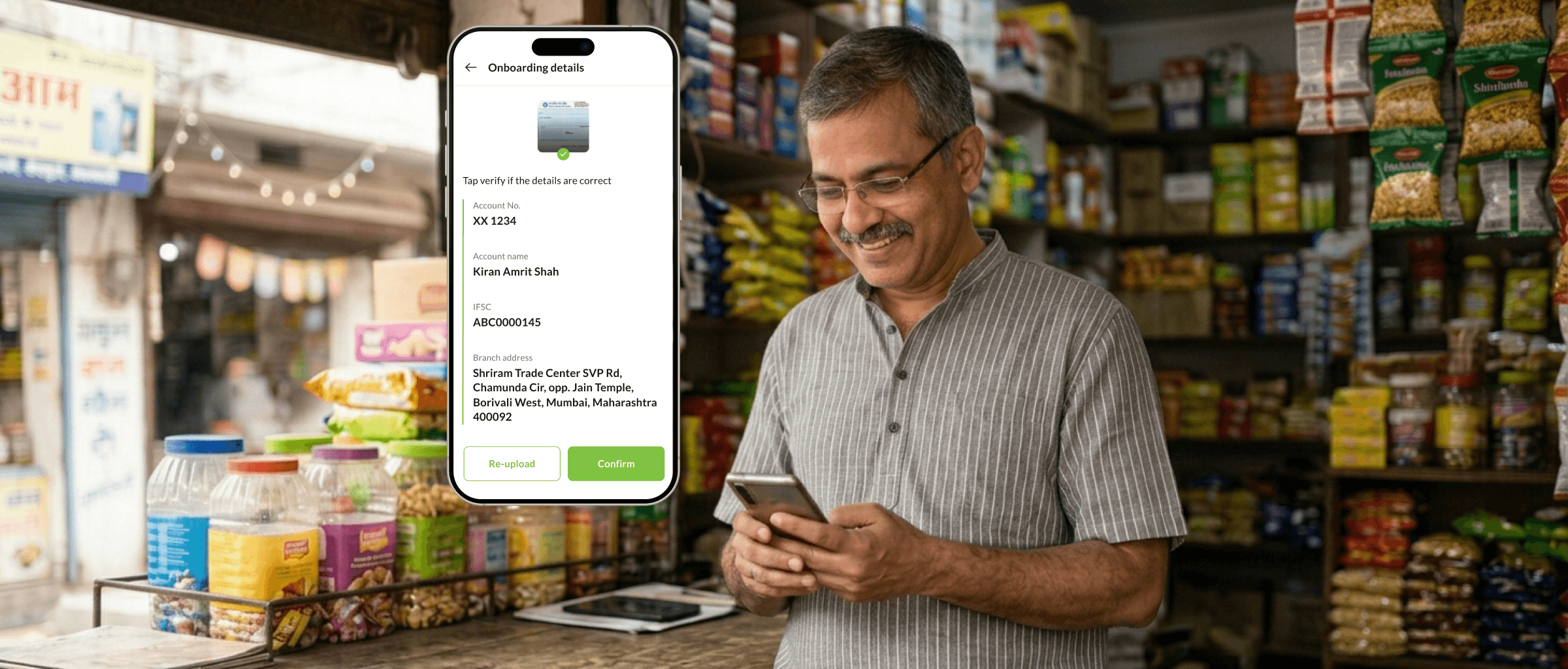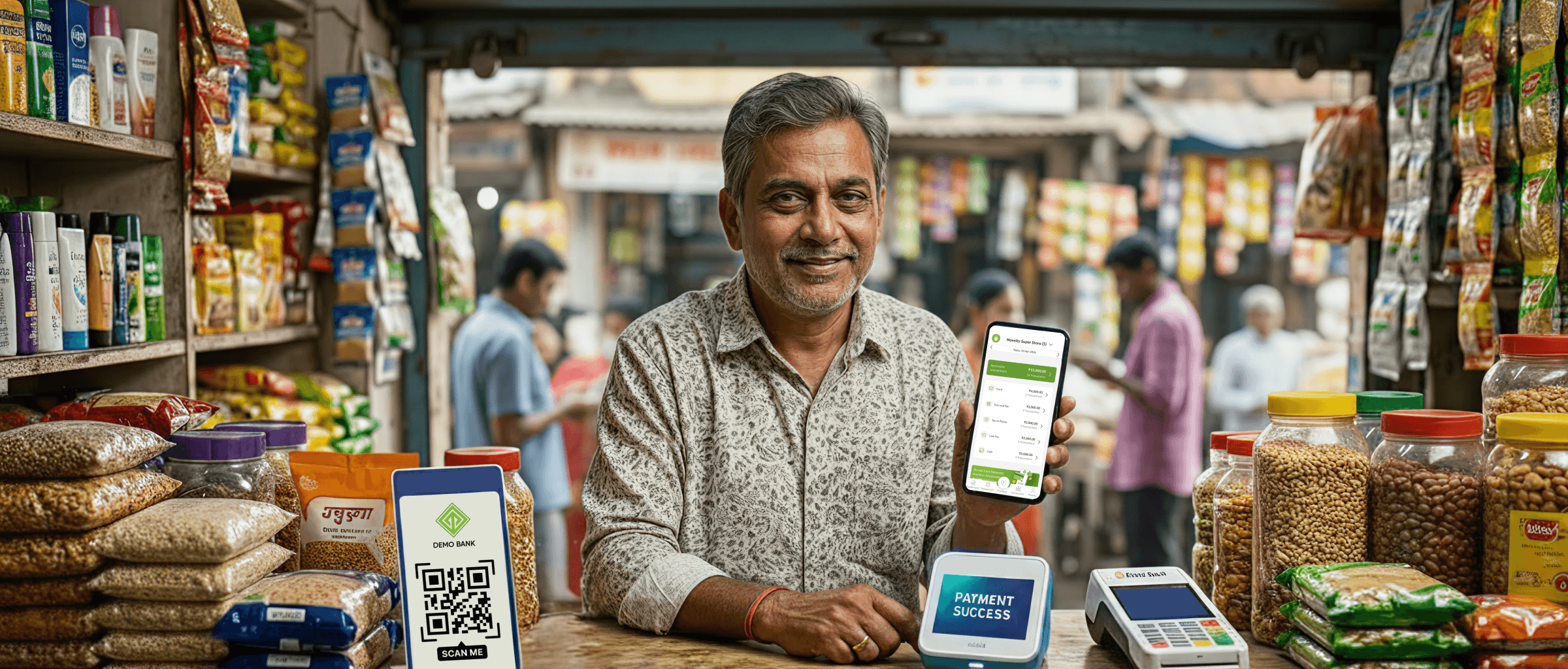
Generated by AI
From Fragmented to Unified: An Implementation Blueprint for Multi-Mode Payment Acceptance at Indian Banks
5 mins
●
ByMintoak
●
20 May 2026

Copy Link


The GPV Growth Imperative for Acquiring Banks in India
India's merchant payment landscape has evolved faster than most bank infrastructure can follow. India now has 665 million QR codes, 11 million PoS terminals, and 23 million Soundboxes deployed across the country - a merchant acceptance infrastructure that has grown 19% in three years. [1] Behind that footprint sits a fragmented stack of siloed channels that most acquiring banks have never unified into a single platform The fragmentation lives at the merchant's counter, not in the back office. A typical SME today juggles a UPI/QR sticker from one provider, a POS terminal from another, a Soundbox from a third, and a payment link service for remote collections, each with its own app, its own dashboard and its own settlement cycle.
The merchant ends the day reconciling across four screens to answer one question: how much did I make today?
This is what the industry has started calling SME digital chaos. The acceptance infrastructure works - payments land - but every additional payment mode adds a layer of operational drag for the person running the shop. Multiple QRs, multiple apps, multiple settlement timelines, no consolidated view of the business. The merchant is the one absorbing the complexity that the ecosystem has created. For acquiring banks, this is the opening. The merchant doesn't need another payment mode added to the pile. They need someone to consolidate the pile. The bank that turns five disconnected acceptance points into a single, unified merchant interface - under one brand, one app, one view - becomes the merchant's primary financial relationship by default. Digital payment volumes in India are projected to grow from 206 billion transactions in FY25 to 617 billion by FY30 - nearly tripling in 5 years. [1] For acquiring banks, the question is not whether that volume will exist. It is whether their merchant platform is unified enough to capture it.
This piece explores what a structured path to unified payment acceptance actually looks like - and why banks that delay this consolidation are quietly ceding ground they may not recover.
The Fragmentation Problem: How Siloed Channels Suppress Merchant GPV
How Indian banks ended up here
Payment mode proliferation in India didn't happen in a planned sequence. UPI QR arrived and scaled rapidly. POS terminals predated it by decades. Soundbox emerged as an audio confirmation layer for high-noise retail environments. Link Pay/SMS Pay were added to serve remote payment collection for delivery-based businesses.
Each one was added as it came along, often through separate supplier ties, integration work, and ways of reporting. The stack works, but it doesn't really fit together.
What fragmentation looks like from the merchant's side
A merchant running QR and POS simultaneously receives settlement in two different cycles, views two different dashboards, and reconciles manually at end of day. If they also use Link Pay for home deliveries, that's a third data stream with no automatic consolidation.
There is no single view of daily GPV (Gross payment volume). There is no mode-wise breakdown that helps the merchant understand where their revenue is actually coming from. The bank's platform becomes a backend utility - present but invisible.
Mintoak's Festive Spending Insights 2025, drawn from over 4 million merchants on the platform, found that digital payment volumes grew 42% year-on-year during the October festive period - with the strongest growth coming from Tier 2 and Tier 3 merchants. Mintoak’s while-label SaaS solution, enables merchant acquirers with a comprehensive payment acceptance module that consolidates payment modes across devices - QR, Soundbox and POS into one merchant app.
What fragmentation looks like from the bank's side
Settlement files arrive from NPCI for UPI, from card networks for POS, and from payment partners for other modes - each in different formats, on different cycles, with different exception categorization logic. Reconciliation teams spend significant time on manual exception resolution. At scale, across thousands of merchants and millions of transactions, this is one of the largest operational cost lines in a bank's acquiring business.
The hidden cost be that fragmented data results in a lack of cross-sell signals
The problem goes beyond operations. Fragmented payment acceptance means fragmented merchant data. A bank cannot offer a pre-approved banking products to merchants if they can’t assess their creditworthiness. Unified payment data is the foundation of every meaningful cross-sell trigger - lending, insurance, deposits, overdraft. Fragmentation doesn't just suppress GPV. It suppresses the entire commercial relationship.
India's SME sector contributes 30% to GDP yet faces an estimated credit and financial services supply gap of ₹30–35 trillion. [1] Unified payment data - the kind that only a consolidated acceptance platform can generate - is the entry point to that lending relationship. A bank that cannot see a merchant's full transaction picture across modes cannot underwrite them.
Architecting a Unified Payment Acceptance Platform: What It Actually Means
One merchant record across all payment modes
A centralized merchant data model means one merchant identity, one terminal hierarchy, and one transaction history - regardless of whether the payment came through QR, POS, Soundbox, Link Pay, or SMS Pay.
This is not the data that’s stitched later to get the full picture of transactions. It is a single record updated in real time across every mode, with the merchant visible to the bank as one coherent entity rather than four separate terminal relationships.
A single API layer abstracting all payment rails
UPI, cards, wallets, BNPL, and payment links each operate on different payment rails and processing frameworks. A unified platform abstracts these complexities behind a common integration and orchestration layer.
The merchant application, along with the bank’s internal systems interacts with a standardized platform interface rather than managing individual payment integrations separately. This enables new payment modes and capabilities to be introduced within the underlying platform with minimal or no changes required in the merchant-facing application or downstream reconciliation systems.
Real-time transaction visibility as a baseline, not a premium
Real-time payment confirmation is not a feature. It is the minimum expectation.
Merchants need to know a payment landed within seconds of it completing - whether through a Soundbox audio alert, a push notification, or an in-app ledger update. Delayed confirmation is one of the primary reasons merchants route transactions through third-party UPI apps instead of the bank's own platform.
UPI alone now processes over 0.5 billion transactions per day across 491 million users and 65 million merchants [1]
- with a target of 1 billion transactions per day by FY28. [1] At that volume, a delayed confirmation is not a minor UX issue. It is a structural reason for merchant churn at scale.
Reconciliation as infrastructure, not a back-office problem
The reconciliation engine must be designed into the platform architecture, not retrofitted. Three-way matching - merchant transaction records, internal bank ledger entries, and scheme settlement files - should run automatically, with exceptions routed to configurable resolution queues based on amount, merchant tier, and payment mode.
Regulatory adaptability built in
The platform must absorb new RBI circulars, scheme mandates, credit-on-UPI developments, and future payment rails without requiring re-architecture. Modular design is the only way to ensure that compliance updates do not become infrastructure projects.
RBI introduced multiple significant regulatory changes in FY24–25 alone - the PRAVAAH portal mandate, the Payments Regulatory Board framework, expanded offline payment aggregator guidelines, and new API usage restrictions on UPI. [1] A platform requiring re-architecture for each new circular is not a compliance asset. It is a liability that compounds with every regulatory cycle.
How Mintoak SmartPayments Implements This
Mintoak's SmartPayments module is built on the unified micro-services architecture. Here is how the implementation works in practice.
All payment modes under one merchant app
SmartPayments consolidates UPI, QR (static and dynamic), card acceptance via POS, Tap to Phone (SoftPoS), Link Pay/SMS Pay, Soundbox audio confirmation, and cash recording into a single merchant-facing application. The merchant does not switch between dashboards or reconcile across separate systems. Every transaction - regardless of mode - appears in one interface, with one settlement view and one transaction history.
During India's October 2025 festive period, Mintoak's platform recorded 44% year-on-year growth in digital payment value across its merchant base - with Tier 3 cities leading at +51% YoY. That growth ran across QR, POS, and Soundbox simultaneously. A unified interface was what made it visible and actionable for both merchants and their acquiring banks.
Real-time confirmation across all modes
Transaction confirmation is delivered within seconds of completion across all acceptance modes. Soundbox devices receive audio triggers through Mintoak's low-latency MQTT-based messaging layer. In-app push notifications happen simultaneously.
For merchants operating in high-noise retail environments - grocery stores, pharmacies, restaurants - Soundbox confirmation is often the primary signal. Mintoak's SoundHub solution manages Soundbox onboarding, device lifecycle, and multi-partner routing from a single platform, removing the operational complexity of managing multiple device vendor relationships for banks like HDFC Bank, AXIS Bank, SBI Bank and more.
Role-based access for multi-location merchants
Through Mintoak's StaffAccess module, business owners can delegate payment acceptance rights to staff across multiple outlets - cashiers who can accept payments but not view settlement reports, managers who can see outlet-level performance, and area managers who can view across locations.
Link Pay/SMS Pay for remote collection
Not every payment happens at a physical counter. Link Pay/SMS Pay allow merchants to send payment requests directly to customers via SMS or messaging platforms, with real-time confirmation returned to the merchant app on completion.
For delivery-based businesses, home service providers, and B2B merchants collecting from trade customers, this mode closes the gap between in-store and remote acceptance - all within the same platform.
White label, bank-branded throughout
The whole experience for merchants is provided using the bank's own brand identity. Mintoak's merchant engagement platform is a white-labeled SaaS solution for merchant acquirer’s, featuring the bank's logo, colour scheme, and communication templates.
For the merchant, the daily interaction is with their bank. For the bank, every login is a touchpoint that reinforces the primary relationship.
Reconciliation at Scale: Eliminating Settlement Chaos
Multi-mode payment acceptance generates settlement files from multiple sources - NPCI for UPI, card networks for POS, internal systems for cash and Soundbox. Each arrives in a different format, on a different cycle, with different exception logic. When amount reconciliation happens at scale, it solves two problems for the merchant.
The first is cash flow. When transactions go unreconciled, that money sits in limbo - processed but not yet closed. Automated matching clears this faster, so funds aren't held up unnecessarily. The second is operational cost. When the merchant has to track down mismatched transactions one by one, it is one of the most expensive things in terms of time and effort. Automation removes that workload at the root, and the savings grow as transaction volumes scale.
India's online merchant payment market alone is projected to reach ₹86 trillion in transaction value by FY30, growing at a 22% CAGR. [1] At that scale, every basis point of reconciliation inefficiency - every unmatched exception handled manually - becomes a material cost line. The operational case for automated reconciliation compounds directly with GPV growth.
Frequently Asked Questions
1. What is a unified payment acceptance platform and why does it matter for Indian banks?
A unified payment acceptance platform consolidates all payment modes - UPI QR, POS, Tap to Phone, Soundbox, Link Pay, and SMS Pay - into a single merchant-facing application with one transaction record, one reconciliation engine, and one settlement view. For Indian banks, it matters because fragmented stacks mean fragmented data. A bank that can't see a merchant's full payment picture across modes can't build a working capital offer, can't detect churn early, and can't compete with aggregators that offer a seamless experience from day one.
2. How does a white-label merchant companion app drive GPV growth for acquiring banks?
When a merchant logs into a bank-branded app daily to check their sales, track settlements, and manage their business, the bank stops being a backend utility and becomes an operational partner. That shift in relationship drives GPV growth in two ways. First, merchants consolidate more of their payment volume through the platform because they trust it and rely on it. Second, higher engagement creates more cross-sell opportunities - working capital, insurance, deposits - which deepen the relationship further and make switching costly.
3. Why is real-time payment confirmation critical for merchant retention?
Delayed confirmation is one of the top reasons merchants route transactions through third-party UPI apps instead of their bank's platform. When a payment lands, the merchant needs to know immediately - whether through a Soundbox audio alert, a push notification, or an in-app update. In high-volume retail environments like grocery stores, pharmacies, and restaurants, a two-second audio confirmation from a Soundbox is often the only signal a merchant can act on in the middle of a busy counter. Instant confirmation isn't a feature. It's the baseline expectation the bank has to meet.
4. How do Link Pay/SMS Pay fit into a bank's payment acceptance stack?
Not every payment happens at a physical counter. Link Pay/SMS Pay allows merchants to send payment requests directly to customers via SMS or messaging platforms, with real-time status updates and confirmation on the merchant app. For delivery businesses, home service providers, and B2B merchants collecting from trade customers, this closes the gap between in-store and remote acceptance - all within the same platform, the same settlement cycle, and the same transaction dashboard. It's the same unified experience, extended to wherever the merchant does business.
5. What does reconciliation look like across a unified POS, QR, Soundbox and UPI solution?
Multi-mode payment acceptance generates settlement files from multiple sources - NPCI for UPI, card networks for POS, and internal systems for Soundbox and Link Pay - each arriving in different formats, on different cycles. A robust reconciliation engine performs three-way matching automatically: merchant transaction records, bank ledger entries, and scheme settlement files. Unmatched transactions route to configurable resolution queues. For CFOs, the outcome is twofold - less capital tied up in unreconciled float, and a structural reduction in the manual exception handling that is consistently one of the most expensive line items in legacy acquiring operations.
6. How does a merchant payment platform in India help banks compete with fintech aggregators?
Fintech aggregators win merchants on experience, not infrastructure. They offer a single app, instant confirmation, and a clean view of the business. Banks have the infrastructure advantage - the acquiring rails, the CBS, the regulatory standing, the existing merchant relationships - but have historically presented it through a fragmented, difficult-to-use interface. A unified merchant payment platform closes that experience gap. When the bank's platform is as easy to use as any other Fintech in the market, the bank wins on both dimensions. The merchant payments engagement platform is how the bank makes that advantage visible.
Mintoak's SmartPayments module is built for exactly this outcome - a unified, white-label merchant payment platform for Indian banks that consolidates all acceptance modes, delivers real-time confirmation, and feeds a single reconciliation and cross-sell layer.
Learn more at mintoak.com/products
References
[1] PwC, 2025 PwC & Global Fintech Fest. (October 2025). The Indian Payments Handbook 2025–2030. Available at: https://www.pwc.in


Conclusion
The window for acquiring banks to establish a differentiated, unified payment acceptance platform is narrowing.
Fintech payment aggregators are moving upstream. They are not just offering payment acceptance, they are offering lending, insurance, and business tools built on top of the payment data they accumulate.
India already has 29 Fintech unicorns - 9 of them in payments - each building deeper product stacks on top of merchant payment data. [1] The acquiring bank that delays platform unification is not just losing a QR code. It is ceding the data layer that underpins every future product in the SME relationship. Banks that delay platform unification risk ceding not just acquiring revenue, but the entire SME banking relationship that flows from daily payment interactions.
Banks that win the next decade of SME merchant acquiring will be those that treat unified payment acceptance not as an infrastructure project, but as core go-to-market differentiation. Mintoak's SmartPayments module - alongside Mintoak DigiOnboard for acquisition, Mintoak SoundHub for device management, and Mintoak SellSmart for cross-sell - provides the structured starting point to begin that transformation today, with a white-label merchant companion app at the front of every merchant relationship.
Share on your socials
Copy Link
Checkout other blogs