Generated by AI
Why African Bank Merchant Apps Break at the Second Outlet and How to Fix It
8 mins
●
ByMintoak
●
09 Jul 2026

Copy Link


The Moment Banks Are Missing: When an SME Opens Its Second Outlet
Africa's SME sector is the continent's economic foundation - roughly 90% of all businesses, contributing between 40% and 60% of GDP across most markets, with an estimated 120 million enterprises by 2025 and fastest growth concentrated in Nigeria, Kenya, and South Africa. [1]
But aggregate figures obscure the moment that matters most to an acquiring bank: the point at which a single-location merchant opens a second outlet. In Mintoak's experience across 4.9 million+ merchants globally in Africa and India, this is precisely when most bank merchant apps stop being useful.
Most apps are designed for one owner, one login, one payment view. A business with two locations, two cashiers, and a manager who cannot be at both simultaneously has already outgrown the platform - not because the bank's payment rails are inadequate, but because the operational layer above them does not exist. This is a product decision, not a technology limitation. Banks that are ready at this inflection point do not just retain the merchant, they become the operational backbone of everything that merchant builds next: the third outlet, the fourth, the franchise model, the credit relationship, the full SME banking stack.
The banks that are not ready lose the relationship silently before a relationship manager notices the GMV drop, before a complaint is filed, and long before a retention campaign can reverse the decision
The African Multi-Outlet Reality: What Makes It Different
The Primary Relationship Is Established at the Formalisation Moment
Across Africa's highest-growth markets, the dominant scaling pattern is informal-to-formal. A merchant opening a second outlet is often formalising payment acceptance for the first time - opening a current account, registering for mobile money merchant acceptance, entering the banking system as a business rather than an individual. The informal economy still accounts for 98% of retail transactions in Nigeria and Cameroon, and approximately 70% in Kenya. [2]
At this moment, the bank is not competing with an aggregator for the merchant's business. It is establishing the primary financial relationship at the exact point the merchant enters formal commerce. That is a structurally different opportunity from winning a merchant away from a competitor - it is the chance to become the institution the merchant has never had reason to leave. Whether the bank capitalises on that moment depends entirely on whether its platform is ready to serve the merchant's operational reality from day one.
The trigger for formalisation is not a revenue threshold set by regulators. It is an operational one: the moment the owner can no longer be physically present at every transaction and needs to delegate payment acceptance, settlement visibility, and daily reconciliation to staff. That is the second outlet. And that is when the bank's platform is either the answer or the problem.
The Chain Store Growth Story Is Already Underway
The homegrown multi-outlet business is not an emerging trend in Africa. It is a current, accelerating reality. These are not foreign franchise imports - they are African businesses that started as single-owner operations and scaled into the continent's most commercially significant merchant cohort:
- Food Concepts (Chicken Republic), Nigeria - crossed 200 QSR outlets as early as 2021, recording over 40% annual sales growth since 2015. [3]
- Sundry Foods (Kilimanjaro, Pizza Jungle), Nigeria - opened five new outlets across Lagos, Abuja, and Port Harcourt in a single quarter in 2022. [4]
- Bokku, Nigeria - a discount retail chain that opened over 100 outlets since 2022, scaling from a single-owner model to a multi-location operation within three years. [5]
- Naivas, Kenya - now operates 110 outlets, posted KSh 114.45 billion in revenue, and recorded a 43.4% jump in net profit in 2025. [6]
Africa's foodservice market is projected to grow at an 11.35% CAGR through 2032, [7] with Nigeria leading expansion at 6.45% CAGR and South Africa commanding 32.4% of continental market share. [8] The merchants scaling from one outlet to many are the defining commercial growth story on the continent - and the acquiring bank that serves their operational needs at the second outlet owns the relationship through the fiftieth.
What Else Makes the African Context Structurally Different
The payment rail environment is fundamentally different from India or Europe. M-Pesa processed KES 83.7 trillion in 2025 - approximately four times Kenya's GDP. [9] In Nigeria, Moniepoint processed ₦412 trillion across 14 billion transactions, claiming approximately 80% of in-person payments. [10] A multi-outlet merchant management tool must consolidate mobile money, bank transfer, and card acceptance in a single role-appropriate view - not privilege one rail over another.
MNOs are not passive infrastructure. MTN MoMo operates across 19 African markets with 70 million+ monthly active users and has stated ambitions to become the continent's dominant fintech platform for merchants. [11] Airtel Money serves 44 million users across 14 countries. Banks are competing not just with fintechs like Moniepoint and OPay, but with distribution networks that predate most bank merchant apps and reach merchants where the bank's branch network does not.
Role-based delegation in Africa carries a structural complexity that most markets do not face. A merchant scaling across five outlets is often doing so across multiple payment rails simultaneously - M-Pesa at one location, MTN MoMo at another, card at a third - while formalising operations for the first time. The delegation challenge is not just access control. It is giving each role a coherent view of a business running across multiple rails, multiple locations, and multiple levels of digital maturity within the same team.
The manager sits at the centre of this complexity - field-based and usually Android-first, overseeing six outlets across Nairobi or Lagos in low-bandwidth environments with no tolerance for a desktop portal that requires a desk to be useful. A platform that cannot serve this person in the field is not a multi-outlet solution for the African market. It is a partial one.
What Breaks When a Single-Login App Meets a Multi-Outlet Business
The failure mode is predictable and consistent across markets. A franchise or retail chain operating five or more outlets has at minimum four distinct user types interacting with payment and settlement data simultaneously:
- Cashiers - payment acceptance at the counter, needing transaction confirmation and nothing else Store managers - reconciling daily settlements, downloading end-of-day reports, managing shift handovers
- Area managers - monitoring GMV across five to ten outlets, identifying underperformers, comparing location-level performance
- Owner / finance tier - pulling consolidated multi-location reports, managing staff access rights, controlling the full financial picture
A single-login portal serves none of them correctly. The cashier sees settlement data they have no business viewing. The manager has no consolidated view across locations. The owner cannot delegate without surrendering control. Every role is either overexposed or underserved - and the merchant's operations team feels that friction every single day.
Credential Sharing Becomes the Default
Without role-based access, the only operational workaround is credential sharing - one login passed across all staff at all outlets. The consequences are direct: full payment data visible to every cashier, no audit trail, no access control, and no ability to identify which staff member initiated which transaction.
This is not a hypothetical risk. African SMEs are disproportionately exposed to insider-enabled fraud precisely because of weak access control systems. The INTERPOL Africa Cyberthreat Assessment 2025 documents the growing insider threat across the continent's financial sector. [12] In Nigeria, financial institutions lost ₦52.26 billion to fraud in 2024 - and the FinTech Association of Nigeria's Chief Operating Officer has stated plainly: "The challenge is not so much one of technology but the insider threat." [13] In Kenya, 67% of SMEs report increased security incidents during digital transitions, [14] and Tanzanian commercial banks reported an 84% rise in cybercrime in Q4 2023 alone. [15]
When credential sharing is the norm, every staff departure is a security event. Every shift change is an unaudited access handover. The bank's single-login architecture does not just fail the merchant operationally - it actively enables the internal fraud risk that responsible merchants are trying to eliminate.
The Bank Loses Visibility Into Business Complexity
A merchant who has expanded from one outlet to five does not typically open five separate bank accounts. Settlement flows through one account - which means the bank sees the aggregate GMV but has no visibility into the operational reality beneath it: that the business now has a management team, regional structure, and cross-location performance dynamics that require a different class of financial product.
The missed signal is not revenue. It is complexity. A merchant processing the equivalent of working capital requirements across five outlets is a different credit risk profile, a different insurance need, and a different product opportunity than a single-outlet operator at the same GMV. Without multi-outlet visibility in the merchant app, the bank cannot see the business it is actually banking.
Reconciliation Becomes Manual Across Locations
Without a consolidated multi-outlet view, end-of-day reconciliation requires calls to each store manager, manual collation of mobile money statements, card payment files, and bank transfer records across locations. This is the operational drag that moves African SMEs toward fintech and MNO platforms - not for better payment rails, but for better operational tools. Moniepoint, OPay, and MTN MoMo are not forcing this choice. The bank is.
The Architecture: Four Capabilities African Banks Must Deploy
Role-Based Access Across Four Tiers
The access model must mirror the real organisational structure of the merchant's business - not what a bank's product team imagines that structure to be, but what the merchant's owner actually needs to delegate and control.
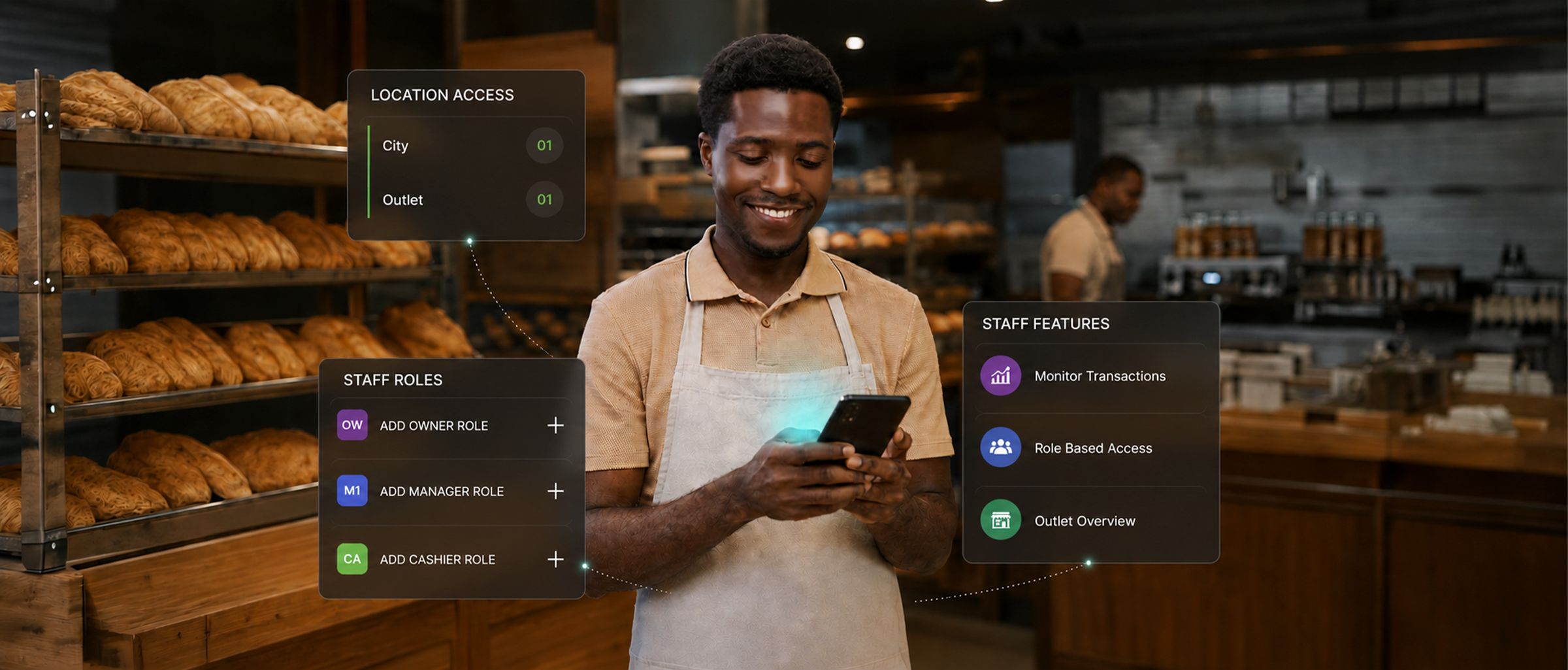
At minimum: a cashier role with payment acceptance only; a manager role with outlet-level reconciliation and report access with consolidated multi-outlet visibility and filtering; and an owner tier with full administrative control.
The role architecture must define three basic tiers - cashier, manager, and owner - each with distinct permissions over payment acceptance, settlement visibility, report access, and outlet-level data. Each tier scoped to what that role actually needs: cashiers confirm transactions and nothing more; managers reconcile settlements and download reports at the outlet level; owners see across all locations and control who has access to what. The hierarchy must mirror how multi-outlet merchants in Africa actually run their operations - without configuration complexity that slows deployment or creates compliance exposure at the point of go-live.
Multi-Rail Consolidation Within the Role Structure
Across East and West Africa, merchants operate simultaneously across mobile money, bank transfer, and card - often on a single trading day. M-Pesa and Airtel Money in Kenya, MTN MoMo in West and Central Africa. A role-based system that consolidates only card transactions is not a multi-outlet solution - it is a partial one that forces the merchant's operations team to manage the remainder manually.
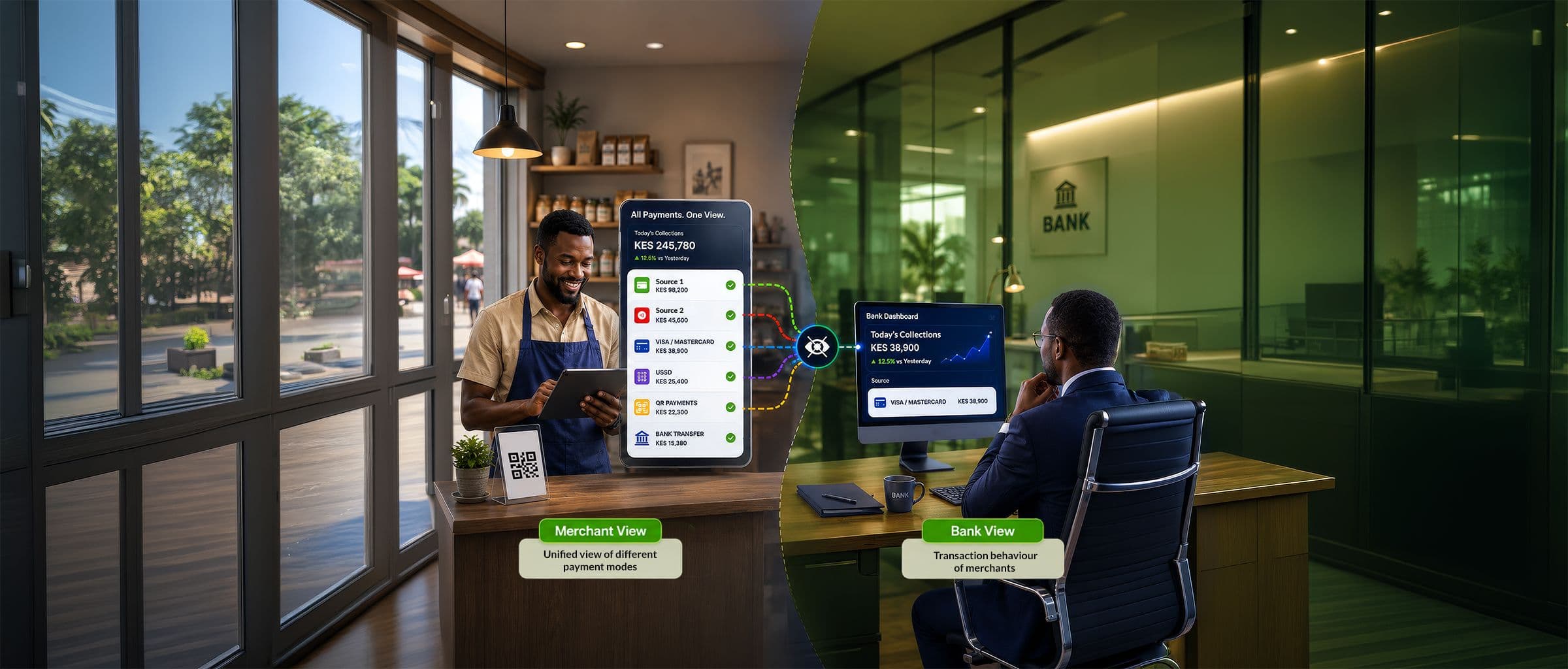
A manager's dashboard must show total outlet performance across all accepted payment modes in a single view. It must capture every settlement regardless of rail. The role architecture is only as valuable as the completeness of the data flowing through it.
Mobile-First Manager Dashboard
The manager dashboard is the single highest-leverage retention feature an acquiring bank can build for chain and franchise merchants in Africa. It creates a daily active use habit at the management level - embedding the bank's platform into the operational routine rather than limiting it to a back-office settlement tool.
The dashboard must surface, in a single mobile view: real-time transaction volumes by outlet, settlement status across locations, top-performing outlets by GMV, and anomaly alerts - an outlet with abnormally low payment volume on a peak trading day. It must be Android-optimised and functional in low-bandwidth environments. Whether the manager logs in daily or ignores the app entirely is determined by whether this dashboard exists. That single behavioural decision is the difference between a merchant embedded in the bank's platform and one evaluating alternatives.
Auditable Access Governance
Every role assignment, login event, and permission change is logged, time-stamped, and attributable at the platform level - meeting the data governance obligations of Nigeria's NDPR, Kenya's Data Protection Act, and South Africa's POPIA, and providing a traceable record against the insider fraud risk documented consistently across African retail markets. [12][14]
Responsible merchants need the assurance that this record exists and is maintained - even when it is not visible to them directly in the app. Banks that can provide that assurance are eliminating a push factor. Banks that cannot are accelerating the migration to platforms that will.
The Business Case: A Revenue Decision, Not a Cost Decision
Operational Stickiness Cannot Be Replicated by Pricing
A cashier who logs into the merchant app ten times daily, a store manager who downloads settlement reports every morning, an area manager who compares outlet performance across regions before noon - their collective switching cost is operational disruption across an entire team. No MNO promotion, no fintech cashback campaign, and no fee reduction undoes that dependency. The merchant is not switching payment processors. They are disrupting the operational infrastructure their entire team runs on. This is the structural retention advantage that role-based access creates - and it is only available to the bank that builds it first.
Multi-Outlet Visibility Unlocks the Next Layer of the SME Relationship
Consolidated payment data across five outlets - visible to the bank for the first time once the merchant's team is embedded in the platform - changes the quality of the SME relationship fundamentally. The bank is no longer looking at a single settlement account. It is looking at a multi-location business with a measurable revenue profile, a cash conversion cycle, and a credit appetite that can finally be sized correctly.
That visibility is what underwrites the next product layer. Working capital lending sized for a five-outlet operation, not a single-location proxy. Business insurance priced against the actual revenue footprint. Invoice financing offered at the moment the merchant's payment data makes the risk transparent. The same data advantage is available to African acquiring banks the moment the platform can see the full merchant - and that visibility begins with the staff access layer.
"Payments are foundational, but they are not where the long-term value lies. Every transaction generates rich, real-time data. That data can be used to unlock high-value services such as working capital access, inventory and cash flow insights, customer analytics, and broader business management tools." - Raman Khanduja, Co-founder & CEO, Mintoak - IBS Intelligence, May 2026 [20]
This is precisely the opportunity African acquiring banks are positioned to capture - but only if the platform gives every member of the merchant's team a daily reason to be inside it. Payments open the door. The operational infrastructure that staff access creates is what keeps it open.
The Build-vs-Embed Decision Has a Clear Answer
Building role-based access natively requires 12 to 18 months of product development, compliance validation across multiple regulatory frameworks, and UAT against live merchant workflows - per market. During that window, Moniepoint deepens its grip on Nigeria's in-person payments, [10] MTN MoMo scales its SME merchant platform across 19 markets, [11] and M-Pesa continues to extend its merchant ecosystem in Kenya. [9] A pre-built, white-label staff access module deployable in 12 to 16 weeks - under the bank's brand, configured to local payment rails, compliant with local data governance requirements - is not a compromise. It is the only commercially viable path to compete in the window that is currently open.
The Structural Context Makes Speed Mandatory
Africa's banking sector is consolidating. The continent's largest banks deployed more than $537 million in cross-border acquisition and expansion deals in 2025, [16] and sweeping recapitalisation programmes in Nigeria and Kenya are accelerating the shift toward fewer, better-capitalised institutions. The CBN raised minimum capital requirements for international-licence banks to ₦500 billion, [17] while Kenya's CBK mandated banks to raise core capital to KSh 10 billion by 2029. [16] The institutions that emerge stronger from this consolidation period will be those that have used the window to build revenue-generating SME relationships - not those that deferred the product investment.
The SME opportunity itself is growing faster than most bank product pipelines can serve. The World Bank approved a $500 million financing package to expand MSME access to formal credit in Nigeria in December 2025, [18] and McKinsey projects the African SME banking segment will grow at 8% CAGR through 2030 - the fastest-growing segment in African banking. [19] The merchants who will anchor that growth are scaling right now. The bank that serves their operational needs at the second outlet will hold the primary relationship when they become the credit, insurance, and business banking customer of the decade.
Implementation: 12–16 Weeks from Decision to Deployment
Start with outcomes, not phases. Before committing to a roadmap, define the three metrics that will tell you whether the deployment is working: active non-owner users per merchant account, frequency of manager dashboard logins, and percentage of role-access merchants deepening their product relationship within 12 months. These are leading indicators of retention value - not lagging signals like churn rates that arrive too late to act on.
Weeks 1-2: Identify the Right Merchants First
Segment the top 10 to 15% of the portfolio by payment volume, outlet count, and growth trajectory - the merchants at or approaching the second-outlet inflection point across Nigeria, Kenya, South Africa, Ghana, Uganda, Tanzania, Zambia, and Botswana. These are the accounts where the retention risk is highest and the relationship value is greatest. StaffAccess is available to all merchants regardless of scale - segmentation determines where to focus onboarding energy first.
Weeks 3-6: Build the Role Architecture From the Merchant Up
Sit with merchant operations teams directly - not relationship managers, who see the account from the outside. Understand how the business actually delegates: who approves refunds, who downloads reports, who has visibility across locations. The four-tier baseline covers most merchant types, but a QSR chain needs a shift supervisor tier, a pharmacy chain needs a dispensary role, a logistics distributor needs driver-level access. Map local data governance requirements - NDPR, Kenya's Data Protection Act, POPIA - into the access architecture at this stage, not as an afterthought.
Weeks 7–10: Integrate, Configure, Brand
API-first integration with the bank’s existing transaction processing and merchant management infrastructure. Every element of the merchant-facing experience - app name, colour, communications - carries the bank’s identity. Payment rail consolidation configured for the market: M-Pesa, MTN MoMo, Airtel Money, card, bank transfer. Mintoak’s deployments with Absa Bank Mauritius and NMB confirm this phase is achievable within the timeline. The constraint is decision speed, not technical complexity.
Weeks 11–16: Onboard Merchants, Not Just Activate Them
Activation and adoption are different outcomes. Activation means the owner has set up roles. Adoption means the cashier is logging in, the manager is pulling reports and checking outlet performance before noon. The onboarding programme must be designed for the second outcome: self-serve role setup for the owner, pre-configured templates for common merchant types, in-app guidance that removes the need for a relationship manager to be involved in routine user management. The model must scale across the portfolio without proportional RM cost.
Frequently Asked Questions
Q1. Why do African bank merchant apps specifically break at the second outlet?
The single-login architecture that works for a sole trader immediately fails the moment a business has two locations and more than one staff member managing payments. A cashier in outlet A and a manager in outlet B cannot share one login without creating a security risk and losing all accountability. Africa's fastest-growing merchant cohorts - QSR chains, pharmacy groups, retail chains - hit this failure point quickly. The platform either grows with them or they find one that does.
Q2. Is staff access only relevant for large, multi-outlet merchants?
No. Even at a single outlet, a business with more than one staff member faces the same problem: no audit trail, payment data visible to all, and the owner unable to delegate without losing control. StaffAccess is available to all merchants regardless of payment volume or outlet count - from a corner pharmacy to a 200-outlet QSR chain. The access problem begins the moment the owner is not the only person touching the payments app.
Q3. How does role-based merchant access connect to cross-sell and credit?
A cashier logging in ten times daily, a manager pulling settlement reports each morning, and comparing outlet performance across regions - every login is a daily active touchpoint on the bank's platform. That consistent engagement creates the context for targeted financial product cross-sell. Mintoak SellSmart - a module that enables banks to surface pre-approved loans, credit cards, and working capital offers to merchants based on eligibility assessment and transaction data - plugs directly into this dynamic. Staff access builds the daily habit across the merchant's entire team. SellSmart converts that habit into fee income for the bank.
Q4. How long does deployment actually take for African banks?
Mintoak’s Africa deployments - including Absa Bank Mauritius and NMB - are delivered in 12 to 16 weeks. That timeline covers API integration with existing merchant management infrastructure, white-label configuration under the bank’s brand, payment rail consolidation across M-Pesa, MTN MoMo, Airtel Money, card, and bank transfer, and structured merchant onboarding. Building natively typically requires 12 to 18 months per market. The gap between those two timelines is the window during which MNOs and fintechs deepen their hold on the merchants anchoring your GMV portfolio.
Q5. What makes the African multi-outlet context different from other markets?
Three structural factors distinguish Africa. First, the informal-to-formal transition means the second outlet often marks a merchant’s first formal financial relationship - making the bank’s platform choice foundational, not incremental. Second, the multi-rail payment environment requires consolidating mobile money, card, and bank transfer in a single role-appropriate view, not just card acceptance. Third, the field-based, Android-first manager means mobile-first is not a feature preference but a basic operational requirement. A platform that ignores any of these is not built for Africa’s merchant reality.
References
[1] Tradehive Africa / African Development Bank - African SMEs: ~90% of businesses, 40–60% of GDP contribution, 120M SMEs projected by 2025.
[2] Quartz / UNECA - Informal retail: 96% of transactions in Nigeria and Cameroon, approximately 70% in Kenya.
[3] Mordor Intelligence / DataInsightsMarket - Nigeria Foodservice Market Report, 2026. Food Concepts (Chicken Republic): 200+ outlets as of 2021; 40%+ annual sales growth since 2015. https://www.mordorintelligence.com/industry-reports/nigeria-foodservice-market
[4] DataInsightsMarket - Nigeria Food Service Market Report, 2025. Sundry Foods Limited: five new outlets opened Q2 2022 across Lagos, Abuja, Port Harcourt.
[5] Finance in Africa / Euromonitor International - Nigeria’s retail market hits $13.2bn, 2024. Bokku: 100+ outlets since 2022. https://financeinafrica.com/insights/nigeria-retail-market-growth/
[6] Shore Africa - Naivas Kenya: 110 outlets, KSh 114.45 billion revenue, +43.4% net profit, 2025. https://shore.africa/2025/11/19/africa-supermarkets-modern-retail-growth/
[7] DataInsightsMarket - Africa Food Service Market, 2025. Projected CAGR 11.35% through 2032.
[8] Mordor Intelligence - Africa Foodservice Market, 2026. South Africa: 32.4% share; Nigeria: 6.45% CAGR. https://www.mordorintelligence.com/industry-reports/africa-foodservice-market
[9] TechCabal - M-Pesa: KES 83.7 trillion ($649.7bn) processed in 2025, approximately four times Kenya’s GDP (CBK assessment). January 28, 2026. https://techcabal.com/2026/01/28/kenya-central-bank-m-pesa-failure-economy-collapse/
[10] TechCabal / Moniepoint 2025 Year in Review - Moniepoint: ₦412 trillion in transaction value, 14 billion+ transactions, 8 in 10 in-person payments in Nigeria, 2025. January 29, 2026. https://techcabal.com/2026/01/29/moniepoint-triples-transaction-volume-in-two-years/
[11] MTN Group Full Year 2025 Results / TechCabal - MTN MoMo: $500.3 billion in transaction value, 23.3 billion transactions, 69.5 million monthly active users, across 16 African markets (19 total MTN markets). March 2026. https://techcabal.com/2026/04/03/mtn-completes-ghana-momo-standalone-fintech-arm/
[12] INTERPOL - Africa Cyberthreat Assessment Report 2025, 4th Edition, May 2025. https://www.interpol.int/content/download/23094/file/INTERPOL_Africa_Cyberthreat_Assessment_Report_2025.pdf
[13] TechCabal - ‘Is cybercrime outpacing Africa’s digital revolution?’ November 2025. ₦52.26bn lost by Nigerian financial institutions in 2024 (NIBSS). Babatunde Obrimah, COO, FinTech Association of Nigeria. https://insights.techcabal.com/is-cybercrime-outpacing-africas-digital-revolution/
[14] Tech in Africa - ‘Cybersecurity Challenges for African SMEs’, November 2025. 67% of Kenyan SMEs report increased incidents during digital transitions. https://www.techinafrica.com/cybersecurity-challenges-for-african-smes/
[15] ResearchGate - ‘The Outlook of Cyber Security in African Businesses’, 2024. Tanzanian banks: 84% rise in cybercrime, Q4 2023.
[16] Finance in Africa / Guardian Nigeria - Africa’s banking titans spent over $537M on expansion deals in 2025 (cross-border acquisitions by five major lenders). Kenya CBK: core capital raised to KSh 10 billion by 2029. December 2025. https://financeinafrica.com/insights/african-banks-537m-expansion-2025/
[17] Nairametrics / Fitch Ratings - Nigeria recapitalisation: CBN raised minimum capital to ₦500 billion for international-licence banks. Deadline Q1 2026. https://nairametrics.com/2025/11/06/fitch-nigerias-banking-sector-recapitalisation-outpaces-sub-saharan-peers/
[18] World Bank - FINCLUDE: $500M MSME financing package approved for Nigeria, December 2025. Fewer than 1 in 20 Nigerian MSMEs have access to bank credit. https://www.worldbank.org/en/news/press-release/2025/12/22/world-bank-approves-500-million-to-expand-finance-for-small-businesses-in-nigeria
[19] McKinsey & Company - ‘From Potential to Performance: A Snapshot of African Banking’, March 2026. SME segment: 8% CAGR through 2030, fastest-growing in African banking. https://www.mckinsey.com/industries/financial-services/our-insights/from-potential-to-performance-a-snapshot-of-african-banking
[20] Raman Khanduja, Co-founder & CEO, Mintoak - quoted in IBS Intelligence, ‘Banks rethink merchant growth’, May 6, 2026. https://ibsintelligence.com/ibsi-news/banks-rethink-merchant-growth-interview-with-raman-khanduja-co-founder-and-ceo-at-mintoak/
[M] Mintoak Platform Data - 55% of engaged merchants explore financial products monthly; 40% of loan disbursals fully unassisted.


Conclusion: The Bank That Grows With the Merchant Owns the Relationship
Africa's SME sector is scaling toward 120 million businesses, [1] and the merchants moving from one outlet to many are the most commercially valuable in any acquiring portfolio - not for what they transact today, but for what they build across the bank's full product suite: payments, working capital, insurance, invoice financing, and business management tools.
The bank present at the second-outlet moment - with role-based payment access, a mobile-first manager dashboard, and a single consolidated view across all outlets and payment rails - is not just processing payments. It is running the merchant's business. Once the merchant's managers are embedded in the platform, the relationship is no longer a payments relationship. It becomes the primary SME banking relationship.
The Merchant Retention Blueprint is a product strategy, not a relationship strategy. It requires building features that serve the merchant's entire team - not just the account owner - and layering capabilities that give every user a reason to open the app beyond payment acceptance. Every quarter a bank delays this decision is a quarter in which Moniepoint, MTN MoMo, and OPay serve the merchants scaling past their second outlet. Those merchants do not return. The operational infrastructure they build their team around becomes the platform they stay on - and the bank that was not ready at the inflection point does not get a second invitation.
Mintoak deploys its core module as an integrated stack - SmartPayments consolidating all payment modes into a single merchant app, Business360 delivering real-time multi-outlet performance insights, StaffAccess enabling role-based delegation across the merchant's entire team, and DigiOnboard handling compliant merchant onboarding and MID generation end to end. Together, they give acquiring banks a complete operational platform for the multi-outlet merchant - deployable in 12 to 16 weeks, under the bank's brand, configured to local payment rails and compliance frameworks.
Share on your socials
Copy Link
Checkout other blogs