Generated by AI
Instant Settlement, Lasting Loyalty: What the Data Says About Merchant Behaviour in India
5 mins
●
ByMintoak
●

Copy Link


The unified platform is the infrastructure. Instant confirmation is what converts it into measurable changes in merchant behaviour and the GPV growth, reconciliation efficiency, and cross-sell readiness that banks are trying to achieve.
Banks across India are deploying unified payment acceptance platforms - consolidating QR, POS, Soundbox, and Link Pay under one app. The infrastructure investment is real. But building the platform is the easier half.
This piece is about the harder half: what actually changes in merchant behaviour once the platform is live and payment confirmation becomes instant or visibly faster. The two are connected because a platform alone does not change how a merchant behaves. What changes behaviour is what the platform delivers at the moment of transaction. A merchant who receives instant confirmation across every payment mode stops hesitating before the next customer, stops steering high-value transactions toward cash, and stops verifying payments on a second app. The unified platform is the infrastructure. Instant confirmation is what converts that infrastructure into changed merchant behaviour and that behavioural change is what drives the GPV growth, reconciliation efficiency, and cross-sell readiness the bank is trying to achieve.
The answer drawn from Mintoak's platform data across one of India's largest bank acquirer deployments and Festive Spending Insights 2025 covering 5.2 million+ SME merchants [2] - is that the behavioural shift is large, measurable, and commercially more important than the architecture that enables it.
Why Confirmation Matters More Than Fund Speed
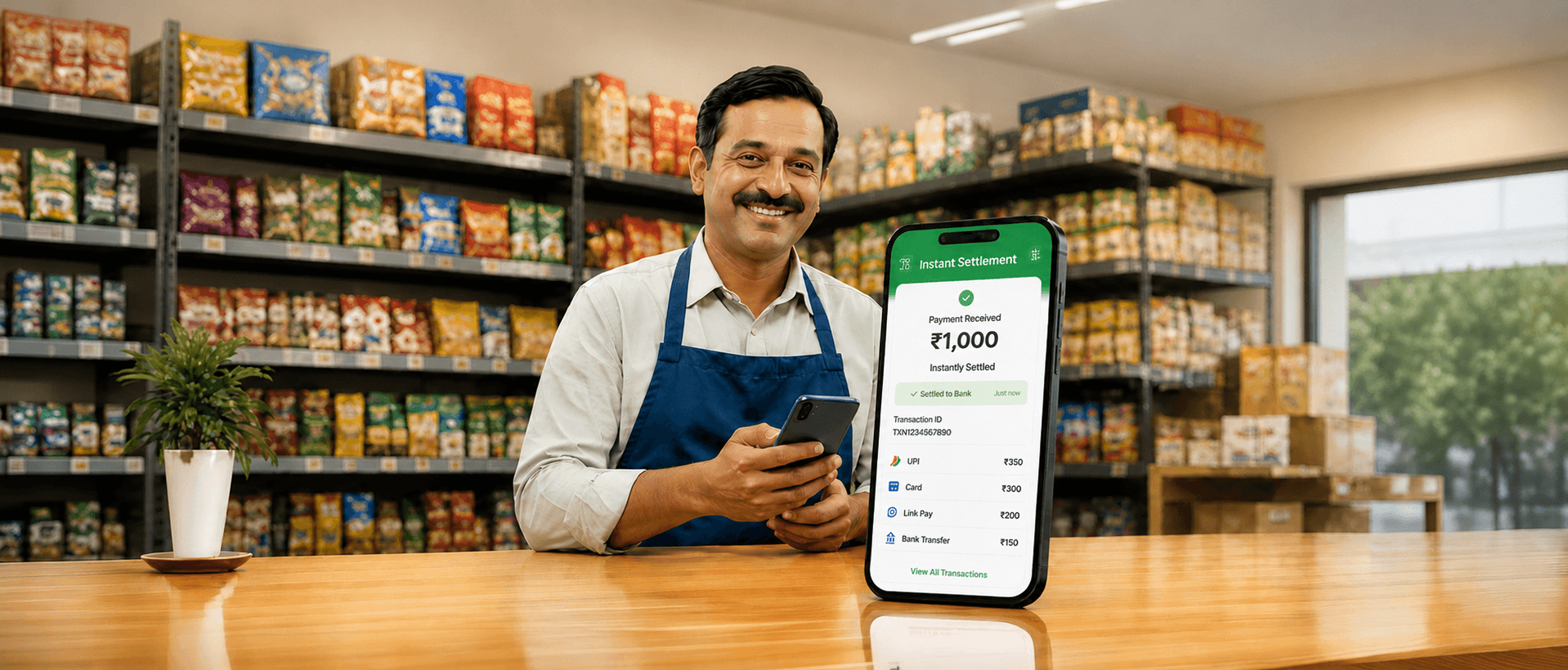
The sharpest behavioural does not solely require same-day fund credit, although this is an important factor, but it also requires confirmation - the immediate signal that a payment has landed. For India's Tier 2 and Tier 3 merchant base, cash has always had one property that digital payments historically lacked: certainty. You heard it. You felt it. The Soundbox audio alert - "payment received, one thousand rupees" - is the digital equivalent of that sound. It closes the trust gap that cash closes.
Approximately 75% of new QR deployments in India are in Tier 2 and Tier 3 cities,[1] where this certainty gap is widest and the behavioural impact of real-time confirmation is most pronounced. Mintoak's Festive Spending Insights 2025, drawn from 4 million+ SME merchants on the platform, found Tier 3 cities posting 51% growth in digital payment value and 49% growth in transaction volume year-on-year in October 2025 [2] - the fastest-growing segment. These are merchants for whom real-time confirmation is not a just UX upgrade, it is a trust prerequisite.
T+0 fund settlement and real-time confirmation are different levers. Confirmation is cheaper, faster to deploy, and produces the sharper behavioural change. For most banks, it should be the first priority.
The practical implication for bank product teams: real-time confirmation and same-day fund settlement are not the same investment. Confirmation infrastructure - Soundbox audio alerts, push notifications, in-app ledger updates - is deployable in weeks. T+0 settlement requires changes to settlement cycles, liquidity management, and sometimes NPCI membership tier. Both are valuable. But confirmation drives the behavioural shift that settlement alone cannot.
Five Behavioural Shifts: What the Data Shows
Shift 1 - Merchants transact more when confirmation is instant: When a merchant no longer needs to stop and check a separate app after every payment, daily transaction throughput increases. Mintoak platform data shows 7x transaction volume growth per merchant following deployment of real-time confirmation across payment modes. [3] The mechanism is not the device - it is the certainty. A merchant confident that every payment has registered, regardless of rail, actively pushes digital over cash for every customer rather than selectively.
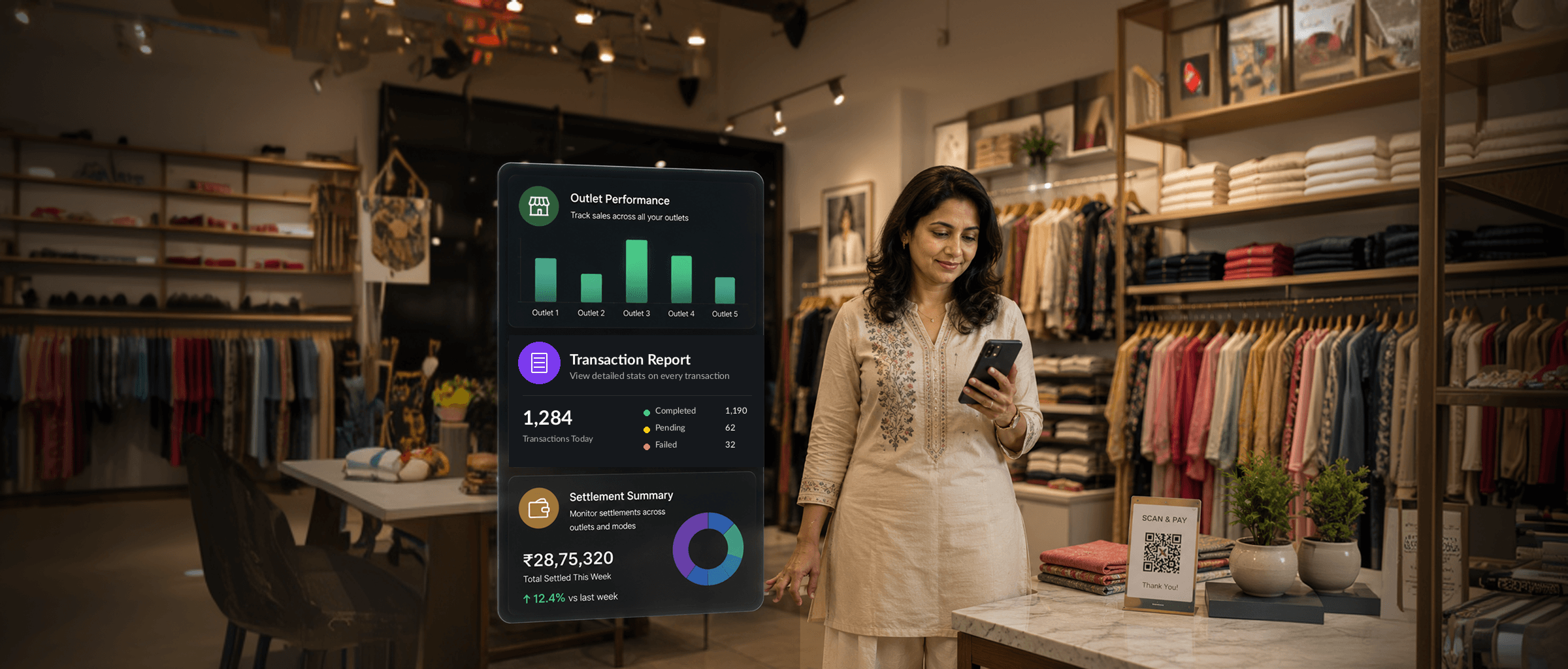
Shift 2 - A unified payment view changes how merchants manage their business: When QR, card, Soundbox, Link Pay, and bank transfer all resolve into a single real-time dashboard, the merchant stops thinking of each rail as a separate income stream and starts seeing their total daily revenue in one number. This shift - from fragmented payment acceptance to unified business visibility - is what drives the 95% Digital GPV growth per merchant Mintoak records post unified platform deployment.[3] The hardware does not change. The merchant's operational confidence does.
Shift 3 - Reconciliation clarity reduces cash dependency: The daily burden of manually matching UPI, card, and cash at end-of-day is one of the primary reasons Indian SME merchants continue to prefer cash for high-value transactions. Not because they distrust digital, but because the accounting is simpler with cash. A unified payment reconciliation view eliminates that advantage. When every mode settles into one report, the operational argument for cash disappears. 84% of industry respondents in PwC's 2025 survey identified real-time confirmation and reconciliation clarity as the primary driver of merchant digital adoption.[1]
Shift 4 - Payment data from a unified platform becomes a creditworthiness signal: A merchant whose full transaction picture across UPI, card, QR, and Link Pay - flows through a single bank-managed platform generates a consolidated payment history the bank can underwrite against. This is the data that SmartPayments makes visible for the first time. On Mintoak-powered platforms, 55% of engaged merchants explore the loans section monthly, 40% of loan disbursals are fully unassisted, and those unassisted loans carry 48% higher average disbursal value.[[5]] Payment data from a unified platform is not just an operational record. It is the foundation of every cross-sell decision the bank subsequently makes.
Shift 5 - High-value transaction routing consolidates onto the bank's platform: Merchants who use both the bank's app and a third-party UPI app route high-value transactions through whichever confirms fastest and reconciles most cleanly. When the bank's payments platform delivers both - instant confirmation across all modes and a single reconciliation view - high-value volume stops leaking to aggregators. This shift is invisible in standard bank reporting but directly moves portfolio GPV. It also expands the credit assessment pool: more transactions on the bank's platform means a richer, more complete merchant financial profile for underwriting.
- 7x Transaction volume growth per merchant post-Soundbox deployment [3]
- 95% Digital GPV growth per merchant post unified platform deployment [3]
- 51% Growth in digital payment value in Tier 3 cities, October 2025 [2]
- 84% Industry respondents citing real-time confirmation as primary adoption driver [1]
The GPV Leakage No Bank Is Measuring
Standard bank reporting measures total transactions processed through bank-issued infrastructure. It cannot see how a merchant splits volume across platforms. A merchant with the bank's QR code and a third-party UPI app on their counter is not choosing between digital and cash - they are choosing between two digital platforms, multiple times a day. The bank's reported GPV looks stable. The potential GPV is materially higher.
This routing leakage is the silent suppressor in most Indian acquiring portfolios. Merchants don't necessarily leave a platform. They simply spread their transactions across multiple platforms. The GPV recoverable from this leakage costs nothing in acquisition; it is already transacting digitally, just through a competitor's confirmation experience. A merchant payment platform in India that delivers faster, more reliable confirmation consolidates that volume without a single new merchant being onboarded.
Across Mintoak's India deployments, we have consistently observed that merchants respond differently to a confirmation arriving through their bank's own app versus a third-party UPI notification. The bank holds their current account, settles their funds, and has regulatory accountability for every rupee. Non-bank platforms can compete on speed but they cannot compete on trust and accountability.
India had 65 million UPI merchant users as of August 2025.[4] A significant share of those merchants are running the bank's QR code alongside a third-party UPI app. The platform that gets their high-value transaction routing is the one that confirms faster. Right now, for many merchants, that is not the bank. Unified payment acceptance with real-time confirmation across all modes is the product intervention that changes this - and it does not require a single new merchant acquisition.
T+0 vs T+1: What One Day Costs in Merchant Behaviour
One day of settlement delay is a working capital gap that repeats every business day. Consider a grocery merchant processing ₹50,000 daily on T+1: they are permanently floating one day's revenue - funds they cannot use to restock, cannot use to pay a supplier, cannot use within the same business cycle. For a pharmacy managing tight reorder cycles or a kirana owner buying produce daily, this is a real friction cost.
The investment framing banks typically apply - "T+0 settlement increases our liquidity requirement" - misses the other side of the equation. Mintoak platform data shows 320% GPV growth within one year of merchant onboarding on the unified platform.[5] That figure reflects the combined effect of unified platform adoption - of which settlement experience is a core driver.
The right question is not "what does T+0 cost us in liquidity?" It is "what does T+1 cost us in routing leakage, GPV suppression, and cross-sell exposure lost to aggregators who settled faster?"
India's digital payment infrastructure is moving in one direction. UPI transactions are projected to reach 1 billion per day by FY28.[1] The merchants generating that volume are making settlement platform decisions daily. Banks that offer a visibly better settlement experience - whether through T+0 fund credit, real-time confirmation, or unified reconciliation - will capture a disproportionate share of the routing decisions that drive portfolio GPV.
Measure the Behaviour, Not Just the Infrastructure
India's digital payment volumes will grow from 206 billion transactions in FY25 to 617 billion by FY30 [1] - nearly 3x in five years. The acceptance infrastructure is being built. Unified platforms are being deployed. The gap most acquiring banks have not yet closed is the measurement gap: tracking not just transactions processed, but behavioural outcomes. Transaction volume per merchant. Routing split between bank and third-party apps. Dormancy reversal rates. Cross-sell conversion among settlement-engaged merchants. These are the numbers that tell the real GPV story - and they are only visible from inside a unified platform that captures the full merchant transaction picture.
Mintoak's SmartPayments module - unified payment acceptance across QR, POS, Soundbox, and Link Pay, real-time confirmation, white-label under the bank's brand, deployable in 12 weeks - is built to make those outcomes measurable, not just deployable.
See how Mintoak SmartPayments drives measurable merchant behaviour change → mintoak.com/products/mintoak-smartpayments
Frequently Asked Questions
1. What is instant settlement and why does it matter for Indian bank merchants?
Instant settlement refers to either real-time payment confirmation - the immediate signal that a transaction has landed, delivered via Soundbox audio alert, push notification, or in-app ledger update - or same-day fund credit (T+0) to the merchant's account. Real-time confirmation is the more impactful of the two for merchant behaviour: it eliminates the hesitation and cash preference that stems from uncertainty about whether a digital payment has gone through. Mintoak platform data shows 7x transaction volume growth per merchant following deployment of real-time confirmation.[3]
2. How does a unified payment acceptance platform drive GPV growth for Indian banks?
A unified payment acceptance platform - consolidating UPI, QR, card, Soundbox, and Link Pay into one merchant app - drives GPV growth through two mechanisms. First, it closes routing leakage: merchants stop splitting high-value transactions across the bank's app and third-party UPI apps, consolidating volume onto the bank's platform. Second, it increases per-merchant transaction frequency by removing the confirmation uncertainty that causes merchants to prefer cash. Mintoak records 95% Digital GPV growth per merchant post unified platform deployment. [3]
3. What is GPV leakage in merchant acquiring?
GPV leakage is the portion of a merchant's digital transaction volume that routes through third-party apps or aggregators rather than the bank's own platform - typically because the bank's confirmation experience is slower or less reliable. It does not appear in standard churn metrics because the merchant never formally leaves; they split their volume. The GPV recoverable from this leakage requires no new merchant acquisition. It is already transacting digitally, just on a competitor's platform.
4. Why are Tier 2 and Tier 3 merchants the highest-impact segment for real-time confirmation?
Tier 2 and Tier 3 merchants are predominantly cash-first businesses in the process of digitising. For them, the uncertainty gap between cash (certain, immediate, physical) and digital (historically uncertain, delayed confirmation) is widest. Real-time audio confirmation via Soundbox closes that gap directly - it is the digital equivalent of hearing cash land in the drawer. Mintoak's Festive Spending Insights 2025 recorded Tier 3 cities posting 51% growth in digital payment value YoY in October,[2] confirming that this segment responds most sharply to confirmation infrastructure improvements.
5. How does SmartPayments turn payment data into a cross-sell signal?
When all payment modes - UPI, card, QR, Link Pay, Soundbox - route through a single bank-managed platform, the bank accumulates a complete merchant transaction history rather than a partial one. This consolidated payment data functions as a creditworthiness signal: it shows GMV, transaction frequency, payment mode mix, and seasonal patterns across the merchant's full business rather than just the bank-routed portion. On Mintoak-powered platforms, 55% of engaged merchants explore the loans section monthly and 40% of loan disbursals are now fully unassisted - evidence that engaged, settlement-confident merchants actively seek financial products.
6. What is the difference between T+0 and T+1 settlement for Indian SME merchants?
T+0 settlement credits funds to the merchant's account on the same day as the transaction. T+1 settlement credits them the following business day. For merchants managing tight working capital like grocers buying produce daily, pharmacists restocking weekly - T+1 creates a permanent one-day float gap that compounds over a month into real cash flow friction. This friction drives high-value transaction migration to platforms or aggregators offering faster settlement, suppressing the bank's portfolio GPV without showing up as merchant churn in standard reports.
References
-
NPCI UPI Product Statistics - 65 million UPI merchant users as of August 2025
-
Mintoak Internal Platform Data - HDFC Bank SmartHub Vyapar deployment, 2024–25: 55% of engaged merchants explore loans section monthly; 40% of loan disbursals fully unassisted; 48% higher average disbursal value for unassisted loans; 320% GPV growth within one year of onboarding.
Share on your socials
Copy Link