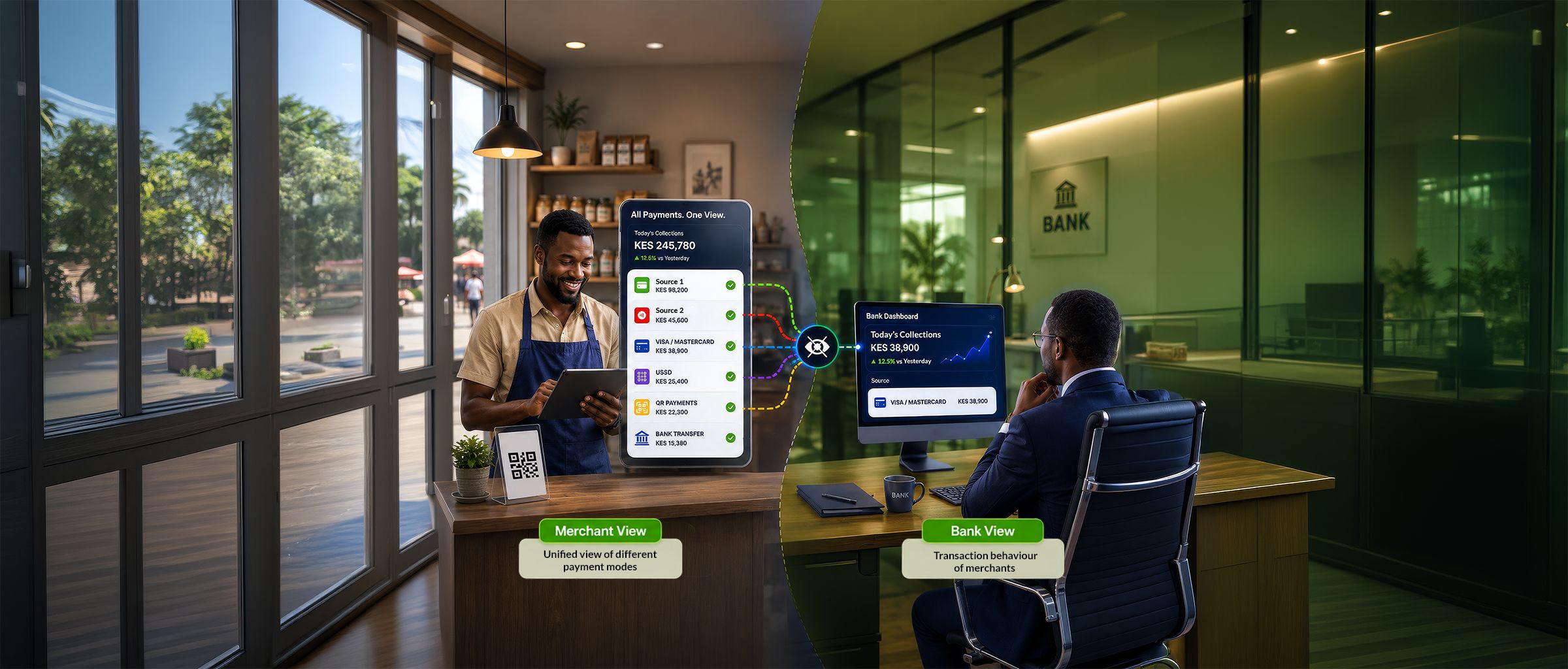
Your Merchants Are Using Four Payment Apps, Your Bank Can See One of Them
5 mins
●
ByMintoak
●

Copy Link


Why fragmented payment acceptance is costing African bank acquirers more than they realise and what unified infrastructure changes.
Africa's digital payments economy is projected to reach $1.5 trillion by 2030, driven by mobile money expansion, rising financial inclusion, and accelerating merchant digitisation.[1] Mastercard expanded its Africa acceptance network by 45% in 2025 alone.[1] Most African acquirers currently operate a fragmented model - mobile money rails, card POS terminals, USSD channels, and QR systems running through separate platforms, separate reconciliation cycles, and separate merchant-facing apps. This is the accumulated result of point-in-time integration decisions made as each payment rail emerged. The commercial cost of that architecture is now compounding across three dimensions: GPV leakage, reconciliation overhead, and card penetration underperformance.
The question is not whether Africa's digital payments market will grow. It is which platform architecture captures that growth for the bank.
Mintoak has deployed unified payment acceptance platforms for institutions including Absa Bank and NMB across Africa, and for HDFC Bank, Axis Bank, and Yes Bank in India, processing $93Bn+ in annualised GMV across 5M+ merchants and 11+ customers. What follows is a direct, data-grounded comparison of what fragmented versus unified acceptance architecture produces across those three dimensions.
The Fragmented Architecture: What Most African Acquirers Are Actually Operating
As of mid-2024, 28 domestic instant payment systems operated across 20 African countries, with 31 more under development[2] Mobile money crossed 2.3 billion registered accounts globally in 2025, with sub-Saharan Africa holding approximately 1.1 billion accounts and over $2 trillion in annual transaction value.[3] USSD handles 64% of all African mobile money transactions - rising to 89% in West Africa. Each of these rails emerged independently, on its own settlement cycle, its own reconciliation format and its own merchant interface.
Consider what that fragmentation looks like in practice for a bank's operations team. A bank running card, M-Pesa, and USSD across its Nigerian merchant portfolio is typically managing three separate settlement files - each in a different format, on a different cycle, delivered by a different counterparty.
- Card settlements arrive from the card network on T+1 or T+2 in ISO 8583 format.
- Mobile money settlements arrive from the MNO's platform on their own cycle, often in a proprietary file format.
- USSD bank transfer confirmations route through NIBSS on yet another timeline.
Reconciling these into a single merchant-level view requires either manual intervention by the bank's operations team or a bespoke integration layer that most banks have not built. The merchant, meanwhile, is running the same three-way reconciliation exercise on their own device manually. An acquiring bank in Nigeria accepting mobile-money-routed transactions, card payments via a third-party POS estate, and USSD bank transfers is operating at minimum three separate data streams, three end-of-day reconciliation processes and in most cases three separate apps on the merchant's device. The result is a double blind spot: from the bank's perspective, the merchant's full transaction picture is invisible; from the merchant's perspective, digital acceptance is operationally more complex than cash. Both outcomes suppress GPV and both are direct consequences of fragmented infrastructure, not of the market.
What Fragmentation Costs: Three Commercial Consequences Acquirers Are Not Measuring
Picture a pharmacy owner in Lagos running two outlets. At the end of each day, she reconciles mobile money payments on one app, card transactions from a separate POS terminal report, and USSD bank transfer confirmations from a third interface - cross-checking totals manually against her notebook to make sure nothing is missing. Or a grocery chain manager in Nairobi whose cashier accepted a card payment but is not sure whether it went through because the confirmation came on a different screen from the one showing the day's mobile money collections.
This is not an edge case. It is the daily operational reality for the majority of African SME merchants accepting digital payments across more than one rail. The anxiety of not knowing whether a payment has cleared - and the time spent finding out - is the merchant-level experience of fragmented infrastructure. What follows is what that experience costs the acquiring bank.
GPV leakage through routing fragmentation: Merchants operating across multiple payment platforms route high-value transactions through whichever confirms fastest and reconciles most cleanly. In African markets, this is typically the non-bank platform, not the bank's merchant app. The bank's reported GPV reflects only transactions routed through its own rails, not the merchant's total digital volume. This gap between reported and potential GPV is the primary cost of fragmented infrastructure. It does not appear in any standard acquiring report, which is why most banks are not measuring it.
Reconciliation overhead: Fragmented infrastructure creates timing mismatches between collections and fund availability, with funds sitting across multiple wallets, payment service provider balances, and intermediary accounts on different cycles.[5] For an SME merchant running outlets across Nairobi, Lagos, or Johannesburg, this is a daily manual reconciliation burden that drives them toward the platform with the cleanest single payment view - regardless of which bank issued their account. The bank's platform loses the daily touchpoint, and with it, the cross-sell data.
Card penetration underperformance: Card acceptance on a fragmented platform requires merchants to operate a separate card device, a separate reconciliation cycle, and a separate settlement timeline from their mobile money transactions. Consultative Group to Assist the Poor’s (CGAP) September 2025 analysis identifies this operational friction - not consumer reluctance - as the primary merchant-side barrier to digital acceptance in sub-Saharan Africa.[6] Card penetration has not scaled alongside mobile money in Africa because of merchant operational complexity, not because merchants don't want card revenue.
What a Unified Payment Acceptance Platform Delivers: Three Measurable Advantages
In working with merchants across acquiring portfolios in Africa and India, Mintoak has consistently observed that what merchants value most is not sophisticated features or rewards mechanics - it is the basics working reliably. Accepting every payment type a customer offers. Seeing all transactions in one place without switching between apps. Knowing instantly that a payment has gone through. These three things determine whether a merchant trusts a platform enough to make it their primary tool. Everything else - loyalty programs, gamified incentives, advanced analytics - only has value once the foundation is right. That is why the measurable advantages of a unified payment acceptance platform come down to these three.
Single merchant view across all rails: Mobile money, USSD, card (Visa, Mastercard, domestic schemes), QR, and bank transfer all resolve into one real-time transaction dashboard - one reconciliation output, one app on the merchant's device. This eliminates the routing arbitrage that drives high-value transactions to non-bank platforms and gives the acquiring bank complete visibility into the merchant's digital transaction picture for the first time.
Real-time payment confirmation across all modes: Every transaction, regardless of rail, triggers an immediate confirmation: audio alert, push notification, in-app ledger update. This is the trust signal that African merchants currently receive from non-bank platforms but not from most bank merchant apps. Mintoak platform data shows 7x transaction volume growth and 95% Digital GPV growth per merchant following unified platform deployment with real-time confirmation.[10]
Card penetration through integration, not sales effort: When card acceptance sits inside the same app and the same settlement view as mobile money and USSD rather than on a separate device with a separate process - merchant card adoption increases without additional training or field activation. The operational friction argument for avoiding a card disappears when the card is one mode inside a platform the merchant already uses daily. This is the architectural path to closing Africa's card penetration gap.
The Closed-Loop Problem: How Fragmented Acceptance Accelerates MNO Dominance
Margin pressure on acquiring in Africa is driven primarily by two forces: low interchange on mobile money transactions and the dominance of closed-loop payment ecosystems operated by large mobile network operators. These ecosystems process transactions entirely within their own rails - the bank sees only the payment entry, not the merchant behavior, not the transaction data, and not the cross-sell signal. The scale of merchant and consumer familiarity with these platforms is not abstract. Africa processed $1.4 trillion in mobile money transactions in 2025 - 66% of global mobile money transaction value - with 347 million active users transacting monthly across the continent.[9] Merchants in Kenya, Nigeria, Ghana, and Tanzania have used these platforms daily for years. The trust and familiarity built over that period is not a feature advantage the bank can replicate with a better app design. It is behavioral inertia and fragmented acceptance deepens it every day the bank fails to give merchants a compelling operational reason to consolidate onto its platform.
A fragmented acceptance model accelerates this dynamic. When the bank's merchant platform does not consolidate mobile money alongside card, the merchant has no operational reason to use the bank's app for their mobile money transactions. They use the MNO's app. The bank's platform becomes a card-only terminal - the lowest-margin, lowest-frequency mode in most African merchant portfolios. The MNO captures the daily touchpoint, the transaction data, and the relationship.
A unified payment acceptance platform that consolidates mobile money, USSD, and cards into a single bank-branded merchant app changes this. Mobile money transactions begin flowing through the bank's platform. The bank gains data visibility across all modes. The MNO loses the daily touchpoint that drives its cross-sell advantage.
This is not a product feature argument. It is a merchant data ownership argument - and merchant data is what underwrites every future cross-sell decision the bank wants to make.
There is a second advantage that unified infrastructure surfaces which is the institutional trust. Across Mintoak's deployments in Africa and India, we have consistently observed that merchants respond differently to a payment confirmation arriving through their bank's own app versus a non-bank platform. The bank holds their current account, settles their funds and has regulatory accountability for every transaction that flows through it. When that confirmation arrives through the bank's branded interface - rather than a third-party app - it carries a weight that non-bank platforms cannot replicate through product design alone. Real-time confirmation through the bank's merchant platform turns that institutional trust into a daily, felt experience. Non-bank platforms can compete on speed. But they cannot compete on the institutional trust that a regulated bank brings to every transaction.
Build vs. Deploy: Two Reasons the Architecture Decision Is Already Made
1. Speed Native build of a unified payment acceptance platform - integrating mobile money APIs, USSD, card network connections, real-time confirmation infrastructure, and a unified merchant app - is a 24–36 month project per market, with separate compliance validation for Central Bank of Kenya (CBK), Central Bank of Nigeria (CBN), South African Reserve Bank (SARB, Bank of Ghana, and Bank of Uganda. During that window, Africa's digital payments market continues to consolidate around the platforms already in place.
2. Merchant segmentation fit, the harder problem to solve
A single-outlet merchant in Lagos with five employees needs one thing from a merchant app: a clear view of payment inflows and outflows, without complexity. A mid-sized chain with 100+ employees across multiple locations needs something structurally different: staff permission controls, role-based dashboards and outlet-level reporting. These are not the same product. A bank building from scratch must correctly anticipate both use cases on the first attempt - or learn through merchant churn and wasted engineering cycles. A platform built across 5M+ merchants in multiple markets has already solved this through live deployment data. It knows that showing a small merchant a feature-packed dashboard would lead to abandonment. It knows that giving a large multi-outlet business a bare-bones app would drive them to competitors. The merchant segmentation problem is solved through deployment experience, not first-attempt product design assumptions.
Mintoak's SmartPayments module presents differently based on merchant profile - lightweight for single-outlet merchants, full-featured for multi-outlet operators - on the same underlying platform. White-label, API-first, deployable in 12–16 weeks. Integrates with existing bank transaction processing infrastructure without replacing it. Live with Absa Bank and NMB in Africa and across HDFC Bank, Axis Bank, and Yes Bank in India, processing $93Bn+ annualized GMV across 5M+ merchants and 11M+ customers.
The Architecture Decision Is a Revenue Decision
Africa's digital payments economy will reach $1.5 trillion by 2030 [1] whether acquiring banks unify their payment acceptance infrastructure or not. The question is which platform would the volume flow through. Fragmented acceptance cedes the merchant data relationship to whichever platform the merchant finds operationally simpler. In most African markets today, that is the non-bank platform. A unified payment acceptance platform changes this and it changes it across every dimension that matters commercially: GPV, reconciliation efficiency, card penetration, and merchant data ownership.
This is not an infrastructure decision. It is a revenue decision. The fragmentation cost is real, compounding, and measurable. It has the same fix.
Learn how Mintoak SmartPayments deploys a unified payment acceptance platform in 12–16 weeks → mintoak.com/products/mintoak-smartpayments
Frequently Asked Questions
1. What is a unified payment acceptance platform for African banks?
A unified payment acceptance platform consolidates multiple payment rails - mobile money, USSD, card, QR, and bank transfer - into a single merchant-facing app with one real-time transaction view and one reconciliation output. For African bank acquirers, it replaces a fragmented model where each rail runs through a separate platform, settlement cycle, and merchant interface - eliminating the GPV leakage and reconciliation overhead that fragmentation creates.
2. What is the best payment acceptance platform for African bank acquirers?
The strongest platform for African bank acquirers consolidates mobile money, USSD, card, and QR into a single merchant-facing app; delivers real-time payment confirmation across all modes; integrates with existing bank infrastructure; and deploys under the bank's brand without a multi-year native build. A white-label platform deployable in 12–16 weeks is the commercially viable alternative to in-house builds.
3. Why does fragmented payment acceptance reduce GPV for African banks?
Merchants route high-value transactions through the platform that provides the fastest confirmation and easiest reconciliation. In a fragmented model, that is typically a non-bank app. The bank's GPV reflects only transactions routed through its own rails - not the merchant's total digital volume. Unified acceptance consolidates routing onto the bank's platform, closing the gap between reported and potential GPV.
4. How does a unified platform increase card penetration among African merchants?
Card acceptance on a fragmented platform requires a separate device, a separate reconciliation process, and a separate settlement cycle from mobile money. CGAP's 2025 research confirms this operational friction, not consumer reluctance, is the primary barrier to merchant card adoption in sub-Saharan Africa.[6] When card is one mode inside a unified app the merchant already uses daily, the friction argument reduces and card adoption follows platform adoption.
5. What payment rails must a unified acceptance platform support in Africa?
At minimum: mobile money, USSD (89% of West Africa mobile money transactions [4]), card (Visa, Mastercard, domestic schemes), QR, and bank transfer. In Nigeria, NIBSS Instant Payment (NIP) accounted for 82.1% of all cashless transactions in 2023 and must be included.[8]
References
Share on your socials
Copy Link